This "F" Images Page Last Updated: Sunday January 06, 2008 - 16:41:44 CST
Check back often, because we are adding new images all the time!


Peregrine Falcon
click on the photo
for a larger view
Peregrine Falcon
[Falco peregrinus]

[Length 16 (Male) to 20 (Female) in. Wingspan 36 (M) to 44 (F) in.]

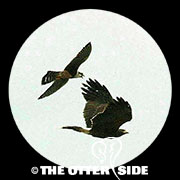
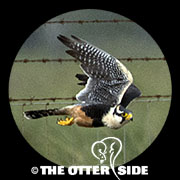
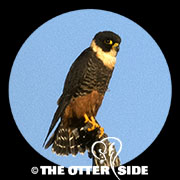
Peregrine Falcons are easily recognized in flight by their large size, long and pointed wings, and "Elvis Presley" sideburns. They are considered to be the fastest animal on earth, reaching speeds of well over 100 miles per hour when they dive or "stoop" on the smaller birds which are their prey. They are almost always found near cliffs (on which they nest) either along coastal areas or near wetlands of some kind. Peregrine Falcons suffered heavy losses in eastern North America during the 1950s, 1960s, and 1970s due to pesticides (primarily DDT), which caused eggs with thin shells to be laid. Indeed, a sighting of a Peregrine during those times would warrant an entry on the local rare bird alert. Western and Alaskan populations were generally unaffected by this. The eastern populations are recovering due to the ban of harmful pesticides, and captive breeding and reintroduction programs sponsored by organizations such as Cornell University. Today, it is possible to see as many as 50 of these magnificent birds of prey in a day at hawk watch migration points such as Cape May, New Jersey. This immature was photographed flying overhead during fall migration at Cape May, New Jersey. Photo taken with a Nikkor 300mm ED f4.5 lens on Kodachrome 200 film. (Date: September 1988)


(use image name "falcop" for inquiries)

Peregrine Falcon
click on the photo
for a larger view
Peregrine Falcon
[Falco peregrinus]

[Length 16 (Male) to 20 (Female) in. Wingspan 36 (M) to 44 (F) in.]

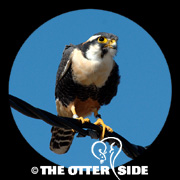
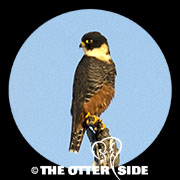
This Peregrine Falcon was photographed at Quivira NWR, KS. Photo taken with a Nikkor 300mm EDAF-S VR f2.8 lens + Nikkor TC20E II 2.0x Teleconverter (EFL=900mm) on a Nikon D200 camera. (Date: May 1, 2007)


(use image name "falcon_peregrine-1004" for inquiries)

Peregrine Falcon
click on the photo
for a larger view
Peregrine Falcon
[Falco peregrinus]

[Length 16 (Male) to 20 (Female) in. Wingspan 36 (M) to 44 (F) in.]

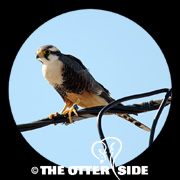
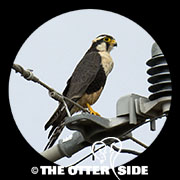
Peregrine Falcons are easily recognized in flight by their large size, long and pointed wings, and "Elvis Presley" sideburns. They are considered to be the fastest animal on earth, reaching speeds of well over 100 miles per hour when they dive or "stoop" on the smaller birds which are their prey. They are almost always found near cliffs (on which they nest) either along coastal areas or near wetlands of some kind. Peregrine Falcons suffered heavy losses in eastern North America during the 1950s, 1960s, and 1970s due to pesticides (primarily DDT), which caused eggs with thin shells to be laid. Indeed, a sighting of a Peregrine during those times would warrant an entry on the local rare bird alert. Western and Alaskan populations were generally unaffected by this. The eastern populations are recovering due to the ban of harmful pesticides, and captive breeding and reintroduction programs sponsored by organizations such as Cornell University. Today, it is possible to see as many as 50 of these magnificent birds of prey in a day at hawk watch migration points such as Cape May, New Jersey. This Peregrine Falcon was photographed at an industrial site in Bayonne, New Jersey. Photo taken with a Celestron 1250mm f10 mirror lens on Ektachrome 200 film. (Date: February 1985)


(use image name "falcp2" for inquiries)

Cassin's Finch
click on the photo
for a larger view
Cassin's Finch
[Carpodacus cassinii]

[Length 6.25 in. Wingspan 11.5 in.]

This male Cassin's Finch was photographed at the Andrews Bird Viewing Trail, Andrews, TX. Photo taken with a Nikkor 70-200mm EDAF-S VR f2.8 lens + Nikkor TC14E II 1.4x Teleconverter (EFL=420mm) on a Nikon D200 camera. (Date: October 24, 2007)


(use image name "finch_cassin's-1001" for inquiries)

Cassin's Finch
click on the photo
for a larger view
Cassin's Finch
[Carpodacus cassinii]

[Length 6.25 in. Wingspan 11.5 in.]

This female Cassin's Finch was photographed on the Kerrville, Texas Christmas Bird Count in December, 2000. Photo taken with a Nikkor 300mm EDAF f4.0 lens on Kodak Elitechrome 200 film. (Date: December 2000)


(use image name "fincas1" for inquiries)

Cassin's Finch
click on the photo
for a larger view
Cassin's Finch
[Carpodacus cassinii]

[Length 6.25 in. Wingspan 11.5 in.]

This male Cassin's Finch was photographed at the Andrews Bird Viewing Trail, Andrews, TX. Photo taken with a Nikkor 70-200mm EDAF-S VR f2.8 lens + Nikkor TC14E II 1.4x Teleconverter (EFL=420mm) on a Nikon D200 camera. (Date: October 24, 2007)


(use image name "finch_cassin's-1003" for inquiries)

Gray-crowned Rosy-Finch - Aleutians
click on the photo
for a larger view
Gray-crowned Rosy-Finch - Aleutians
[Leucosticte tephrocotis griseonucha]

[Length 7.25 in. Wingspan 14.75 in.]

Gray-crowned Rosy-Finches are sparrow-sized birds with a rich brown back and breast, a deep rose-colored belly, a rosy wash across the wings, and a black head with gray sides and back. Females are the same basic color pattern, but duller overall. They breed across most of Alaska (including the entire Aleutian Island chain) except the far northern tundra, and along the mountains of western Canada, western Washington, western Oregon, and western Montana. In winter they move to lower elevations and south throughout the mountains and foothills of western Canada and the western US. The Aleutian Gray-crowned Rosy-Finch is noticeably larger and shows more gray on the face than its mainland cousins. This male "Aleutian" Gray-crowned Rosy-Finch was photographed on Attu Island, Alaska. Photo taken with a Nikkor 500mm f8.0 mirror lens on Ektachrome 200 film. (Date: May 1988)


(use image name "gcrfin" for inquiries)

Gray-crowned Rosy-Finch - Aleutians
click on the photo
for a larger view
Gray-crowned Rosy-Finch - Aleutians
[Leucosticte tephrocotis griseonucha]

[Length 7.25 in. Wingspan 14.75 in.]

This male "Aleutian" Gray-crowned Rosy-Finch was photographed on Attu Island, Alaska. Photo taken with a Nikkor 300mm ED f4.5 lens on Kodachrome 200 film. (Date: May 1988)


(use image name "gcrfin2" for inquiries)

| Previous Page | Next Page |

| Back to the "F" Image List Page | Back to the Complete Image Catalog |

| Back to THE OTTER SIDE Home Page |

Copyright © THE OTTER SIDE
Last Updated: Sunday January 06, 2008 - 16:41:44 CST