This "Anhinga/Cormorant/Pelican" Images Page Last Updated: Saturday March 03, 2012 - 18:48:31 CST
Check back often, because we are adding new images all the time!

Birding Top 1000 Counter

Red-faced Cormorant
click on the photo
for a larger view
Red-faced Cormorant
[Phalacrocorax urile]

[Length 29 in. Wingspan 46 in.]

It is easy to see how the Red-faced Cormorant got its name. It is a glossy black color with a bright reddish-orange facial patch and light bill (the similar Pelagic Cormorant lacks the bright face patch and always has a black bill). Red-faced Cormorants occur in southwestern Alaska and the Aleutian Islands in North America, and the Kamchatka Peninsula and far northern Japan in Asia. They are strictly coastal, and nest in colonies on cliff faces and rocky islands with Murres, Gulls, and Kittiwakes. This one was photographed on St. Paul Island in the Pribilof Islands of Alaska. Photo taken with a 300mm f4.5 Nikkor ED lens on Kodachrome 64 film. (Date: June 1984)


(use image name "cormrf" for inquiries)

American White Pelican
click on the photo
for a larger view
American White Pelican
[Pelecanus erythrorhynchos]

[Length 62 in. Wingspan 108 in.]

American White Pelicans are common breeding birds on prairie lakes in the US and Canada. In winter, they often occur in large flocks along the southern coasts of the US, where their synchronized group fishing looks like a ballet on water. The fish are scooped up into their expandable throat pouches along with a considerable amount of water. The water is then drained by holding the bill straight up in the air. American White Pelicans often soar and circle high in the air like hawks, vultures, and other birds of prey. This American White Pelican was photographed at Rockport Beach, Rockport, TX. Photo taken with a Nikkor 300mm EDAF-S f4 lens (EFL=450mm) on a Nikon D100 camera. (Date: March 27, 2004)


(use image name "pelican_american_white-1001" for inquiries)

American White Pelican
click on the photo
for a larger view
American White Pelican
[Pelecanus erythrorhynchos]

[Length 62 in. Wingspan 108 in.]

This American White Pelican was photographed at Goose Island State Park, TX. Photo taken with a Nikkor 70-200mm EDAF-S VR f2.8 lens (EFL=300mm) on a Nikon D200 camera. (Date: February 8, 2008)


(use image name "pelican_american_white-1002" for inquiries)

American White Pelican
click on the photo
for a larger view
American White Pelican
[Pelecanus erythrorhynchos]

[Length 62 in. Wingspan 108 in.]

This American White Pelican was photographed at Goose Island State Park, TX. Photo taken with a Nikkor 70-200mm EDAF-S VR f2.8 lens (EFL=300mm) on a Nikon D200 camera. (Date: February 8, 2008)


(use image name "pelican_american_white-1005" for inquiries)

American White Pelican
click on the photo
for a larger view
American White Pelican
[Pelecanus erythrorhynchos]

[Length 62 in. Wingspan 108 in.]

These American White Pelicans were photographed in the bay at Corpus Christi, Texas. Photo taken with a Nikkor 300mm ED f4.5 lens on Kodachrome 64 film. (Date: November 1980)


(use image name "pelicw2" for inquiries)

American White Pelican
click on the photo
for a larger view
American White Pelican
[Pelecanus erythrorhynchos]

[Length 62 in. Wingspan 108 in.]

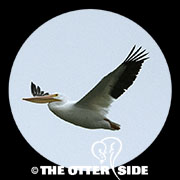
This American White Pelican in flight was photographed at Corpus Christi, Texas. Photo taken with a Nikkor 300mm ED f4.5 lens on Kodachrome 64 film. (Date: November 1980)


(use image name "pelicw3" for inquiries)

American White Pelican
click on the photo
for a larger view
American White Pelican
[Pelecanus erythrorhynchos]

[Length 62 in. Wingspan 108 in.]

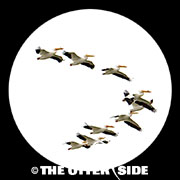
American White Pelicans are common breeding birds on prairie lakes in the US and Canada. In winter, they often occur in large flocks along the southern coasts of the US, where their synchronized group fishing looks like a ballet on water. The fish are scooped up into their expandable throat pouches along with a considerable amount of water. The water is then drained by holding the bill straight up in the air. American White Pelicans often soar and circle high in the air like hawks, vultures, and other birds of prey. These were photographed flying along the Rio Grande River in southeastern Texas. Photo taken with a Nikkor 300mm ED f4.5 lens on Kodachrome 200 film. (Date: January 1988)


(use image name "pelicw" for inquiries)

Brown Pelican - Atlantic
click on the photo
for a larger view
Brown Pelican - Atlantic
[Pelecanus occidentalis ??]

[Length 51 in. Wingspan 79 in.]

Brown Pelicans occur in tropical coastal waters of the New World. They are common, but decreasing, along the southern coasts of the US. They fish by diving headfirst into the water and scooping up fish with their elastic throat pouches. When not actively fishing, they often rest on jetties and pilings, as this one was doing when it was photographed in a marina along the southern Florida coast. This one was photographed at the Flamingo Marina in Everglades National Park, Florida. Photo taken with a 300mm f4.5 Nikkor ED lens on Kodachrome 200 film. (Date: January 1991)


(use image name "pelib2" for inquiries)

| Previous Page | Next Page |

| Back to the "Anhinga/Cormorant/Pelican" Image List Page |

| Back to the Complete Image Catalog |

| Back to THE OTTER SIDE Home Page |

Copyright © THE OTTER SIDE
Last Updated: Saturday March 03, 2012 - 18:48:31 CST